

Learning Culture and Psychological Safety work together, but where should we start?
By Andy Elwood, accredited by Matthew Syed Consulting & Academy of Brain-based Leadership to help you build Psych Safety & a learning culture in your organisation.
In brief: A learning culture is one where people routinely ask questions, seek feedback, share mistakes and use what they learn. It needs two things working together: the habits of learning, (which are what people believe and do) and the safety to show them, (which is what the social environment allows). Most organisations haven’t spent time thinking about this and don’t know which is weaker. Wouldn’t it be great if there was something which could help you get a read on this?
Why “which comes first?” is the wrong question
This is the wrong question because both serve the same goal, ie: a culture where people learn as fast as the work changes. Prof. Amy Edmondson’s research starts from learning, not from safety. Her original 1999 study[1] of 51 teams in one manufacturer found that psychological safety was strongly linked to how much teams learned, and that learning behaviour was the route through which psych safety reached performance. It was a single-company, cross-sectional study, so it shows a link rather than proving cause. Although, her first piece of advice to leaders follows from it: frame the work as a learning problem, not an execution problem, because where there is uncertainty and people depend on each other, everyone’s brains and voices are needed. She calls the place to aim for the learning zone and says it is one and the same as the high-performance zone when uncertainty and interdependence are present. In a November 2025 interview, she put it simply: high psychological safety means a high learning quotient.
Timothy R. Clark’s model reaches the same place from another angle. Learner safety, the second of his four stages of psychological safety, asks one question: is it safe to learn, ask and make mistakes? Psych Safety’s January 2026 analysis [2], written by co-founder Jade Garratt, adds a useful distinction: psychological safety is about what people believe about their environment, while growth mindset is about what they believe about people, including themselves. Put together, psychological safety is the condition, mindset is the habit, and a learning culture is the result.

What a rescue helicopter career taught me about learning
Experience from my helicopter rescue career backs up the academic work form the theory quoted above: ‘Every day is a school day’ was the phrase we used day in and day out on Royal Air Force rescue helicopters. It’s so much more than a slogan. It’s the way that individuals and crews were valued & rated in that environment. Showing up at work with an attitude for learning was valued by crew mates & colleagues, as we found it was the best way to consistently produce best performance from rescue crews, when it mattered most. An attitude for learning is what keeps us safe today, and it’s how we grow and perform better tomorrow, as individuals and as a team. The same holds in any organisation where the work is uncertain and people depend on each other.
Where UK organisations stand right now
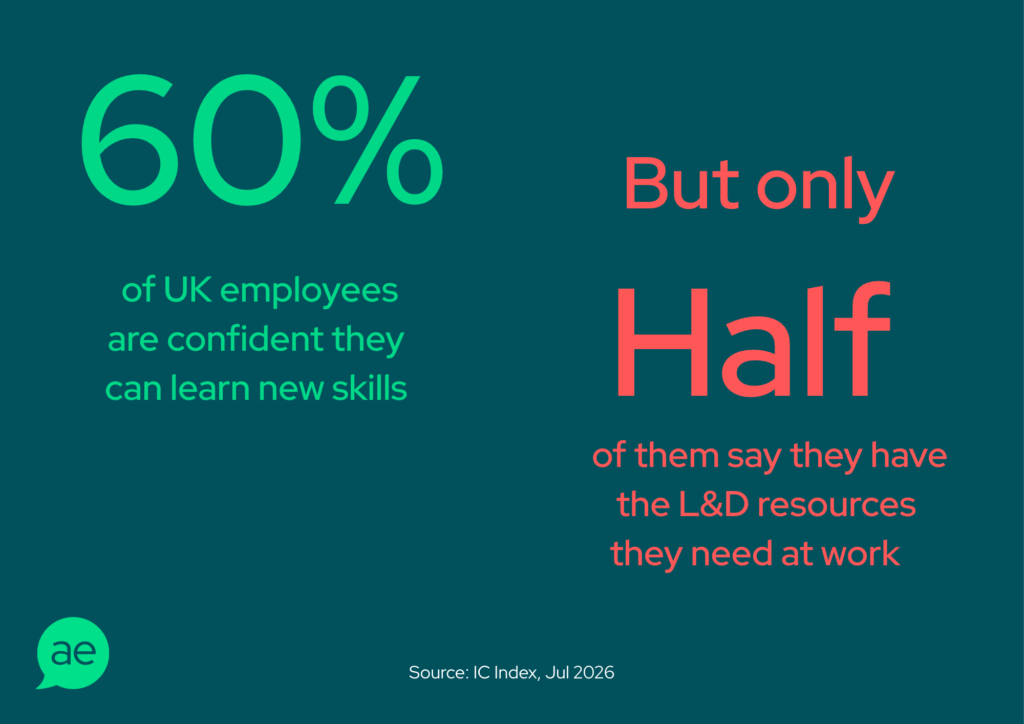
UK workers want to learn, but many are not getting the backing or the safety to act on it. PwC’s UK Hopes and Fears Survey [3], published in September 2026 and covering 2,023 UK workers, found that 60% are confident they can learn new skills, yet only half of them say they have the learning and development resources they need at work. These numbers don’t describe a psychological safety problem or a mindset problem on its own. They describe a learning gap: people who think they can grow, in workplaces that are not yet set up to let them. Which half of that gap is widest in your organisation, the habits or the safety, is the question that decides where to start, and it is one most HR Directors can’t answer today, without measuring it.
How to benchmark your learning culture at three levels
The best way we know to do this is Mindset Advantage, a psychometric from Matthew Syed Consulting that is registered with the British Psychological Society. It takes 15 to 20 minutes online and measures nine attitudes and behaviours (growth, attitude to feedback, humility, attitude to failure, belief in potential, curiosity, attitude to complexity, agility and collaboration) alongside six aspects of culture (support for calculated risk-taking, ownership and commitment, trust, fostering innovation, valuing potential over pedigree, and freedom). In practice, these are the everyday habits of a learning culture, and the conditions that let them flourish. The report outputs are in three levels:
Individual. Each person gets a personal report showing their strengths and blind spots across the nine behaviours, with development actions focused on the three where they have the most room to grow.
Team. For teams of seven or more, team-level results show shared strengths and blind spots against benchmarks, so a manager can see how the team learns together, not just how each person does.
Organisation. Culture questions show how people perceive the organisation, including how well it cultivates a learning culture. Leaders receive an executive summary and a 60-minute debrief to agree next steps.
Senior leaders get the headline picture, but the individual reports are where change happens. They give people at every level, and their managers with the individual’s invitation, a clear outline of their strengths and blind spots. With structured help to turn that feedback into action, this individual report becomes the basis for growth over time, for the individual and for the organisation. Pairing each report with feedback conversations, produces better results & engagement, rather than emailing it and walking away. The British Psychological Society’s 2019 review made a similar point: it noted that the report is written for the participant, and that the instrument would benefit from being linked to workshops and consultancy. That’s where we can help.
One principle matters here. A person’s report belongs to them. It’s designed for development, not for selection or promotion, and it’s theirs to share with a manager in a feedback conversation, when they choose. That protects trust, and it keeps the focus on learning rather than judgement. There is also a place here for improving how managers give and receive feedback through this ongoing process.
What happens if you skip the learning step
Two failure modes are worth naming, because both are common. The first is safety without learning: leaders tell people it is safe to speak up, but nothing changes about how mistakes, ideas and setbacks are treated once they’re voiced, so trust in the message erodes fast. Clark’s advice is to name the lesson out loud when something goes wrong, so that people can see the upside in what went wrong. The second, flagged by Psych Safety’s January 2026 analysis, is that mindset can be ‘mis-used’ and be interpreted as pressure: telling a struggling colleague they simply need “more of a growth mindset” while the environment around them stays as risky as before. That turns a learning idea into a way of blaming individuals for systemic problems. A learning culture avoids both traps because it asks what the team and the system can learn, not who is at fault. This brings people together shoulder to shoulder in joint learning, rather than a blame game or finger pointing behaviour just to survive the hunt for who’s fault is this?
Where to start
- Benchmark. Run Mindset Advantage across a team, a function or the whole organisation, to see where the habits and the conditions are strong, and where they are thin. You’ll identify strengths and blindspots, which give behaviour to continue and areas to focus on.
- Feedback. Turn individual and team results into structured conversations, so every report leads to one or two specific development actions. Top Tip* – ask for advice on something specific, rather than ‘Any feedback for me?’ and you’re much more likely to get meaningful observations, suggestions & encouragement.
- Build the conditions. Where the data shows safety is thin, work on what leaders do: frame the work as learning, encourage leaders to go first reflecting on mistakes and naming the lesson. Use our ‘HUMAN’ framework to help you role-model and ‘Ask’ better questions so you move ‘Upstream’ with your psych safety & learning culture.

You can repeat the benchmark after a suitable period to identify what has moved.
Frequently asked questions
What is a learning culture?
A learning culture is one where people routinely ask questions, seek and give feedback, share mistakes and use what they learn to improve individually and as teams. It depends on both the habits people bring and an environment that makes it safe to show them. You could think of this as feeling safe for ‘learning out loud.
Is a learning culture the same as psychological safety?
No. Psychological safety is a condition: the shared belief that it is safe to speak up, ask questions and admit mistakes. A learning culture is what that condition makes possible. Amy Edmondson’s 1999 research found that learning behaviour was the route through which psychological safety affected team performance.
What does Mindset Advantage measure?
It measures nine individual attitudes and behaviours linked to growth mindset, such as attitude to feedback, attitude to failure and curiosity, plus six aspects of organisational culture. It produces reports for individuals, teams and organisations identifying strengths & blind spots for ongoing performance & development, rather than labelling people or teams as having a ‘growth mindset’ or ‘fixed mindset’ full stop.
Who sees an individual’s Mindset Advantage report?
Each person receives their own report, which is designed for personal development rather than selection or promotion. The individual has control over when and how to share their report in a feedback conversation with their manager or with their colleagues. Team and organisation reports show combined results.
What should a Director do first?
Benchmark first, so you know where your gap is widest. In our view, most organisations get more traction starting with learning habits, because they are quick to measure and low risk. When we Measure, then we can Reflect and Improve.
Where to go from here
If you are planning culture work for the year ahead, a benchmark is the quickest way to avoid spending in the wrong place. Book a confidential chat with Andy, no sales pitch. Talk about what’s going on where you work or what your vision is or your primary focus… ask your questions.
Not ready for a call just yet? Start with our free five-minute self-check, which shows whether your gap is in the habits or the safety.
Or book yourself onto our next free Strategy Briefing.
This article was researched and drafted with AI assistance, then fact checked, edited and approved by Andy before publication.
References
- Psychological Safety and Learning Behavior in work teams 1999
- Growth Mindset article on pschsafety.com
- PwC’s UK Hopes and Fears Survey Sep 2026