
The Hidden Cost of Silence: What Employee Voice Is Really Worth to Your Organisation
By Andy Elwood, accredited by Academy of Brain-based Leadership & Matthew Syed Consulting to help you build Psychological Safety & a Mindset Advantage.
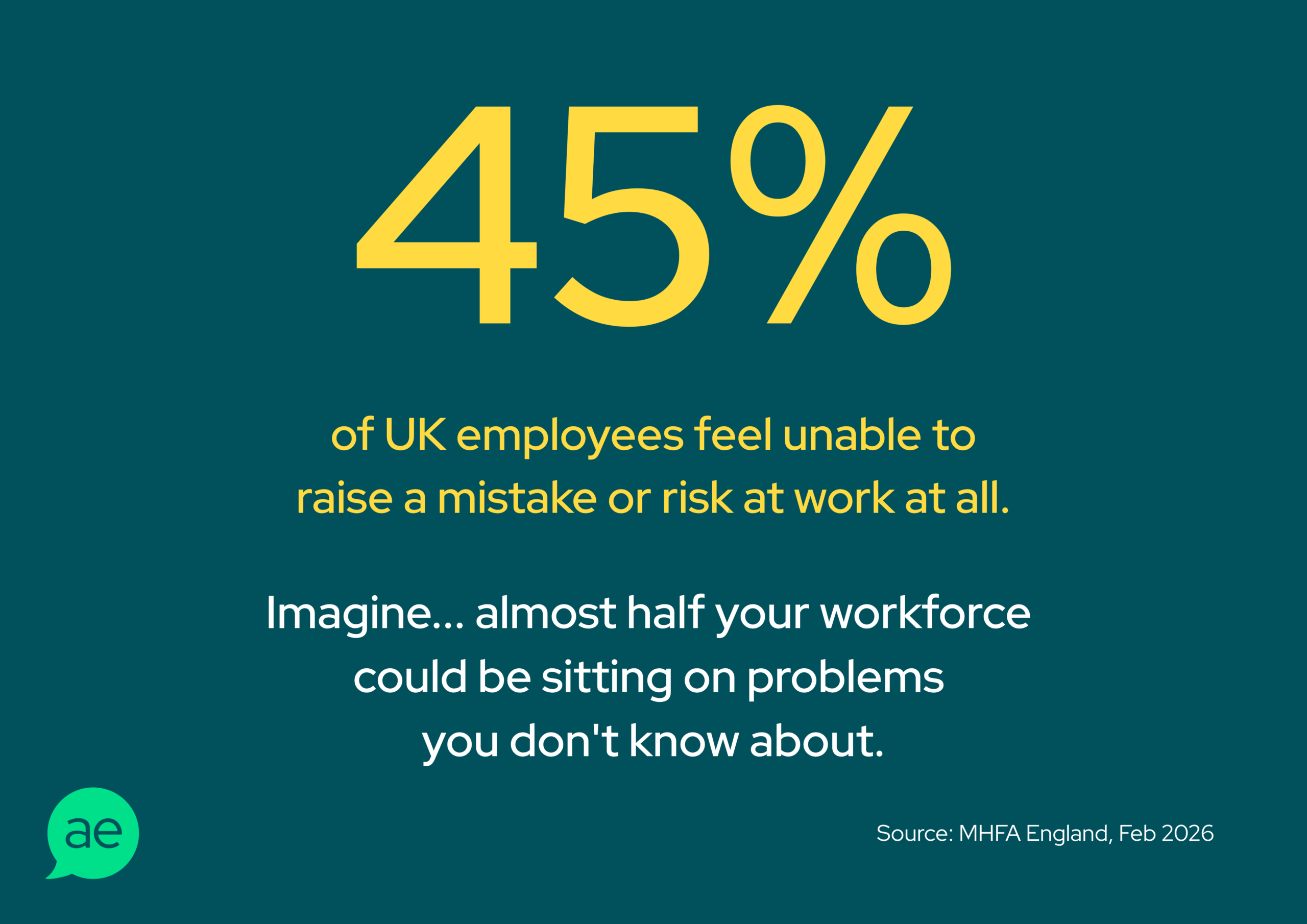
In brief: Employee silence isn’t a soft culture issue, it is a measurable operational risk. 2026 figures from MHFA England found that 45% of UK employees feel unable to raise mistakes or risks at work, and 15% say they have already made a preventable mistake because they felt unsafe speaking up1. CIPD research adds that a quarter of employees report high levels of silence overall2. Each of those numbers represents problems that were visible to someone in your organisation upstream, before they became problems you had to fix.
What silence actually costs
The clearest evidence is the most direct. In a report published by MHFA England in February 2026, based on 2,000 working adults across the UK, 15% of employees said they had already made a preventable mistake because they felt unsafe speaking up. That’s not a hypothetical cost, it’s a documented one and sits alongside 45% of employees, who feel unable to raise mistakes or risks at all and 49% who don’t feel comfortable expressing their needs at work. Every risk that goes unflagged, every early warning that never reaches a manager, carries a cost that only becomes visible once it has already happened1.
I use the story of a helicopter rescue of three cragfast climbers on Ben Nevis to illustrate how people do speak up when we create the right environment for them to do so. Audiences love this illustration and a typical reaction from people is captured up by Claire’s quote, below, after a Psych. Safety session in Derby.
“The best example of psychological safety that I’ve heard – so powerful!” – Claire Whitehead-Wall, Consultant
How common is workplace silence, really?
More common than most leadership teams assume. Alongside MHFA England’s figures, CIPD’s Employee Voice research, 2026 found that a quarter of employees report high levels of silence at work2, and its Good Work Index shows the most common response to workplace conflict is simply to let it go3. That is a quarter of your workforce choosing not to say what they see, not because they have nothing to say, but because the perceived cost to them of speaking up outweighs the perceived benefit. CIPD’s own analysis is direct about why: employees stay silent when they judge the risk of speaking up is higher than the value of raising the issue, when it comes to their job security, standing or relationships.
What voice is worth when it actually speaks out
The upside is just as measurable as the cost of losing it. CIPD’s research links genuine employee voice to higher productivity, more innovation, reduced conflict & absenteeism; alongside improved wellbeing, motivation plus job satisfaction for the people doing the voicing2. None of this requires a large programme to start capturing. It requires people believing that what they say will actually be heard and acted on, which is a different problem to solve than simply providing more channels to speak through. This is not about creating a new reporting system or regular town hall meeting but about listening so people feel heard, rather than judged and that whatever they share will be valued & accepted as worthy to consider.
This is a psychological safety issue, not a communication problem
Adding more surveys or suggestion boxes will not fix silence on its own, because the barrier is rarely a lack of channels. Prof. Amy Edmondson’s research, and Google’s ‘Project Aristotle’ both identified psychological safety as the strongest single predictor of team effectiveness, ahead of individual talent or experience. Employee silence is what low psychological safety looks like in practice. People are not withholding information because they lack a way to share it. They are withholding it because, consciously or not, they have judged that sharing this is not safe.

What this means for your culture strategy
Treat the willingness to speak up as a metric worth tracking on its own, separate from general engagement scores, because it tells you something engagement scores do not: whether people trust that raising a problem will actually change anything. If your organisation has never measured this directly, that itself is worth noting, since it means the 45% and 15% figures above could just as easily describe your own workforce as any other’s.
Frequently asked questions
What is the cost of employee silence?
Research from MHFA England found that 15% of UK employees have made a preventable mistake specifically because they felt unsafe speaking up, and 45% feel unable to raise mistakes or risks at work at all1. The cost shows up as errors, missed risks and lost innovation that could otherwise have been flagged early.
Is employee silence the same as low engagement?
Not exactly. An employee can appear engaged in day to day work while still staying silent about a specific issue, mistake or concern. The decision to speak up depends on the perceived risk to them directly in the moment verses the potential value to the business in the future; rather than their general engagement with the job.
How common is workplace silence in the UK?
CIPD research found that a quarter of employees report high levels of silence at work2, and their Good Work Index, 2024 found the most common response to workplace conflict is simply to let it go rather than raise it3.
What is the single biggest driver of employee voice?
Psychological safety. Research from Amy Edmondson and Google’s Project Aristotle study both found it to be the strongest predictor of team effectiveness, ahead of individual skill or experience, because it determines whether people believe speaking up is safe.
Is a psychological safety diagnostic different from a standard staff engagement survey?
Yes. An engagement survey typically measures how people feel about their job and their workplace in general, whereas a psychological safety or silence diagnostic measures something narrower and more actionable: whether people believe it is safe to raise a specific risk, mistake or concern right now. An organisation can score well on engagement, while still having a genuine silence problem sitting underneath it.
How do we find out how much silence is costing our own organisation, rather than relying on national averages?
The figures above are a useful benchmark, but they describe the UK workforce in general, not yours specifically. Take the Pressure and Silence Scorecard, to get a working answer for your own organisation in a few minutes, rather than assuming the national numbers apply to you.
Where to go from here
If you don’t currently know how many of your people are staying silent about risks they can see, that’s the first gap worth closing. Take the free Pressure and Silence Scorecard to see where your organisation stands right now.
“Andy did an absolutely great job of delivering the session (Psych Safety Team Debrief) to us. It really got everyone thinking about psychological safety and how this may be integrated and enhanced within the College”… “his approachable and non-judgemental nature really allowed people to connect into the training.
Thanks very much.” – College of Paramedics
“Big thanks to Andy for delivering a really impactful workshop. His story is inspiring and his approach to teaching is highly accessible! I’ve definitely taken away some reflective points” – Will Broad, Marketing & Communications Manager, Rail Forum.
Since you’ve read this far, your next step is to Book a Strategy call for a chat about benchmarking where your organisation stands today, identifying blindspots and building a plan to close them.
This article was researched and drafted with AI assistance, then fact checked, edited and approved by Andy before publication.
References
- MHFA England, ‘The cost of workplace silence’ February 2026
- CIPD, Employee Voice Factsheet, 2026
- CIPD, Good Work Index, 2024