

5 Coaching Questions Every Manager Should Ask (Bonus: They Build Growth Mindset and Psychological Safety)
By Andy Elwood, accredited by Academy of Brain-based Leadership & Matthew Syed Consulting to help you build Psychological Safety & a Mindset Advantage.
In brief: Manager engagement has fallen to 22% globally, (down 5 points in the last year), according to Gallup’s State of the Global Workplace 2026 report and Gallup’s research consistently finds managers account for 70% of the variance in team engagement. What Gallup found was that managers trained in effective coaching saw their own performance improve by 20 to 28%, and their teams saw engagement rise by up to 18%; with the effect still measurable 9 to 18 months later. The five questions below are a practical starting point for you or your management team. We’ve chosen these carefully because each one does double duty building growth mindset and psychological safety during the same short conversation, started by a great question…
Use coaching questions to build a coaching habit that matters
A single well asked question, repeated consistently, can change what happens in a team. Gallup’s 2026 data shows global employee engagement has fallen to its lowest point since 2020, and the sharpest declines are among managers themselves, the group whose behaviour shapes 70% of their team’s engagement. The best evidence on developing managers as coaches comes from a structured Gallup programme, with eight to 16 learning modules, coaching calls and cohort calls, not from questions alone. Managers who completed it did better than comparable peers on performance, and their teams’ engagement improved by up to 18% more. It was Gallup’s own programme, studied across its clients without randomisation, so it is encouraging rather than conclusive. The five questions below are not from that programme, but they’re our suggestion for small, repeatable habits in the same spirit.
The five questions
Each question is framed to build a learning culture and psychological safety.
1. What’s one thing you’re finding difficult right now, and what have you already tried? This question invites honesty about struggle without treating struggle as a weakness, and it signals that effort matters as much as outcome, the foundation of a learning culture & growth mindset conversation.
2. What did you learn from that, whether or not it worked? Asking this regardless of outcome removes the pressure to only report successes, and it teaches people that the value of an attempt is in what it revealed, not simply whether it succeeded.
3. What would you need from me to feel able to raise this earlier next time? This question puts the responsibility for psychological safety where it actually sits, with the manager, and asks directly rather than assuming you already know the answer.
4. If that approach didn’t work, what would you want to try differently next time? This keeps the conversation future focused and practical, reinforcing that setbacks are information to build on rather than verdicts on someone’s ability.
5. What’s one thing I do that makes it harder for you to speak up, and what would help instead? This is the most direct of the five, and often the most uncomfortable to ask. It works because it models the exact behaviour, admitting a possible mistake and inviting honest feedback, that you want your team to feel safe doing themselves.
Why these questions work together
None of these questions work in isolation as a script to run through once. Their value comes from being asked consistently, in everyday one to one chats, until the pattern itself becomes the message: it’s normal here to talk about what’s difficult, what was learned, and what would help. Gallup’s data on best-practice organisations shows what is possible: in 2025, 79% of their managers were engaged, nearly four times the global average of 22%. The data doesn’t show why, but it does show that the low figure is not inevitable. Think of James Clear’s approach in his book Atomic Habits, “You do not rise to the level of your goals. You fall to the level of your systems.” These five questions help you create that system level, which will carry the performance in the difficult times because you’re valuing and role-modelling psych safety & a learning culture.

Frequently asked questions
Do these questions work in a single conversation, or do they need repetition? Repetition is what makes them effective. Asked once, they read as unusual. Asked consistently as part of regular one to ones, they build a pattern and normalise a different approach or expectation that people come to expect and trust. When people feel safe to learn then their behaviour can actually shift.
Why do these questions build both a learning culture and psychological safety at the same time? Growth mindset is about believing ability can develop through effort, and psychological safety is about believing it is safe to be honest about that effort while it is still developing. Each question asks about effort and learning in a way that assumes both, without requiring a polished outcome first.
What if a manager asks these questions and gets silence in response? That’s a useful signal in itself, and worth treating as information rather than failure. It usually means trust needs to be rebuilt gradually first, often by the manager modelling honesty about their own mistakes before asking others to do the same. It’s always great to have a recent example of struggle of your own to offer first to role-model what you’re asking of someone else.
How is this different from a standard coaching training programme? Standard training is often a single event. The Gallup programme behind the figures above was longer, with eight to 16 learning modules, coaching calls and cohort calls, and managers applied what they learned back at work. Gallup did not test which part drove the results, so we cannot say. These questions are designed to be the everyday habit, asked consistently in ordinary one to ones, rather than another course.
Where to go from here
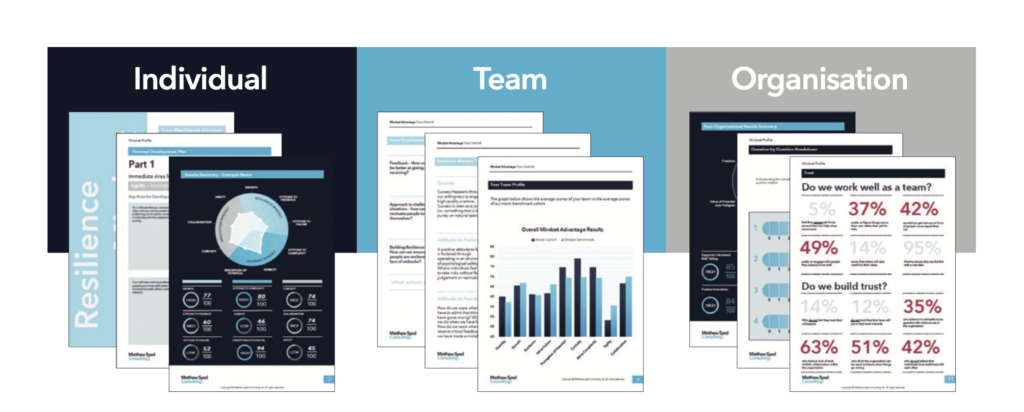
If you’re experiencing any kind of middle-manager bottleneck or stall at this level, you’re not alone. Imagine if you could turn this around to access more collaboration, development & innovation. Try these five questions and then you might want to consider measuring where things are in your organisation, before deciding how to move forward. We find Mindset Advantage (developed by Matthew Syed Consulting) really helpful to measure, reflect & improve on multiple levels within organisations. It’s a great focus point for people & their managers on day to day tasks, on larger projects and also in more formalised check-in conversations, rather than leaving everything to the dreaded annual one-to-one…
Grab our free download on these questions.
Just ask us and we’ll drop you some info or have a chat with us on Stand B29 at the annual CIPD Exhibition, where we’re sharing our ‘ASK better questions’ card (A of our HUMAN model).
Find out more about our HUMAN model and how it could help your organisation, or claim your free diagnostic at CIPD ACE 4-5th Nov 2026 in Manchester.
Not attending or reading this after the event? Drop us an email on chinwag@andyelwood.com OR
Schedule a call for a confidential chat about your organisation, your people, or the culture you’re aiming to build.
This article was researched and drafted with AI assistance, then fact checked, edited and approved by Andy before publication.
References:
- Gallup, ‘How Managers Impact Team Productivity’ Sep 26
- Gallup, ‘Manager development Strategy’
- Gallup 2022 meta-analysis PDF