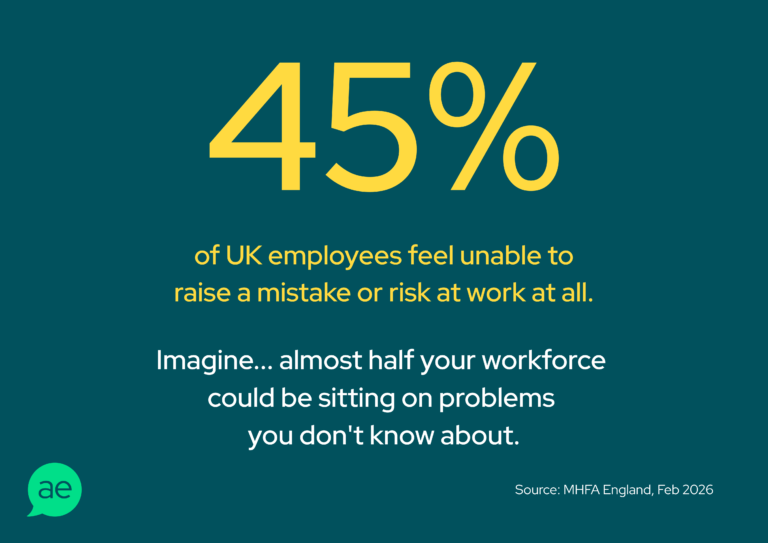


Psychological safety is the special ingredient to happy, high performing people and teams.
Only when someone feels safe, will they start to tell you what’s happening; what’s really going on; what they’re worried about; what they are unsure about. It’s only when someone feels safe, that they can be courageous enough to ask a vulnerable question, point out a mistake or even ask for help.
Amy Edmondson, professor at Harvard Business School, has a longer definition in her academic work, but also uses the definition that psychological safety is ‘feeling that your voice is welcome.’ This applies to whatever you are saying and whenever you are asking difficult questions. This definition implies a feeling that you belong, that you are valued and included by the by the person or the persons you are talking with, especially in the workplace!
Psychological Safety is Key in Business
Google’s ‘Project Aristotle’ showed that the key factor in all their high-performing teams was psychological safety. This builds on Amy Edmondson’s previous research.
Your people do their best work when they feel comfortable around others, because they know it’s safe to ask a question, offer a suggestion, critique a plan, talk about a mistake. In short, your people do their best work when they feel that their voice is welcome. Psychological safety is about including people, making people feeling welcome and encouraging them to contribute because their contributions are valued.
When business leaders see the humans in front of them and identify human issues in business situations, their teams start to thrive rather than burn out. When leaders understand that being human is the potential for the business, rather than a weakness, that’s when they are taking the first steps towards transforming the business into the high-performing teams they have always dreamed of.

Business Lessons from Helicopter Rescue Crews
Having psychological safety was key in the high-performance rescue helicopter crews Andy flew with in his previous career. Psychological safety was built and strengthened by years of flying together in crews, but it all began with ground training in Human Factors.
This about recognising one’s own limitations as a human and how best to harness that for better team performance as a crew. It’s called Crew Resource Management (CRM) in aviation and it’s an integral part of annual training to be legally compliant. That’s how important it is. It’s not only about being safer flying together, but also about high-performance as a team in dynamic life-threatening situations. Applying these principles in business improves engagement, collaboration and enables high-performance teams.

Psychological S.A.F.E.T.Y.™ Model Creates High-Performance Teams
The recent breakthroughs in neuroscience have enabled great progress since Professor Amy Edmondson developed the idea (1999) and Google’s project Aristotle’s results (2015) brought the concept of Psychological Safety into wider public domain as the No.1 factor present in their high-performing teams.
By studying the human brain, neuroscientists have identified social factors which can trigger the powerful threat response in our brains. The Academy of Brain-based Leadership have developed the S.A.F.E.T.Y. ™ model from this research to help us understand our own brain’s needs first and then others, so that we can improve our working relationships, interactions and teamwork for higher performance.
Andy’s Exclusive UK Accreditation
Andy is one of a few accredited UK facilitators by The Academy of Brain-based Leadership to deliver Team S.A.F.E.T.Y.™ Debrief days. This is a key part of his vision to share lessons from helicopter rescue crews with business to improve high-performance teams. Using the brain-based Psychological S.A.F.E.T.Y.™ model is the best way we know to create high-performance teams in business.
Get in touch to find out more and secure a private session for your team.
Email: chinwag@andyelwood.com